

Last updated: August 2026
Why Invoice Automation Matters Now
Plan managers are operating in a time of growing pressure. Rising administrative costs, new NDIA reforms, and the introduction of funding periods mean that efficiency and compliance have never been more important.
Every claim now needs to be accurate, compliant and submitted inside the right window, or it does not get paid.
Invoice volumes have not dropped to match. Most plan management teams are processing more invoices with the same staff, or fewer.
This is where invoice automation becomes essential. An invoice automation system handles the capture, validation and processing of invoices with minimal manual input.
Instead of spending hours entering data, cross-checking line items, funding balances, and correcting errors, the software handles these tasks automatically.
Careview’s Streamline NDIS Software takes this one step further.
Powered by Zespy, an AI-driven engine purpose-built for NDIS invoicing, Streamline delivers exceptional accuracy (95% success rate) in data capture and processing. This means plan managers can reduce errors, cut costs, and save valuable time while staying aligned with NDIS invoicing and record-keeping requirements.
What Is an Invoice Automation System?
An invoice automation system is software that manages the full invoice lifecycle, from receipt through to payment, without repetitive manual work.
Manual data entry is the single biggest time drain in invoice processing — and one of the most common reasons NDIS plan managers start looking for an invoice automation system in the first place. Every hour spent keying in line items, checking totals, and re-entering the same details across systems is an hour not spent on participant outcomes.
Manual entry is the single biggest time drain in plan management, and the cost compounds:
- Time lost to repetition. The same invoice details often get typed more than once, into a claims system, a ledger and a compliance record. Each entry is another chance to introduce an error.
- Higher rejection rates. Mistyped figures, missed fields and mismatched participant details are among the leading causes of claim rejections.
- Slower payments. Every manual step adds delay between service delivery and provider payment, which creates friction for providers and participants alike.
Careview’s Streamline is built to remove manual data entry from this equation. Instead of staff transcribing invoice details by hand, Zespy reads and extracts key information directly from emails, PDFs, and scanned documents — accurately and automatically.
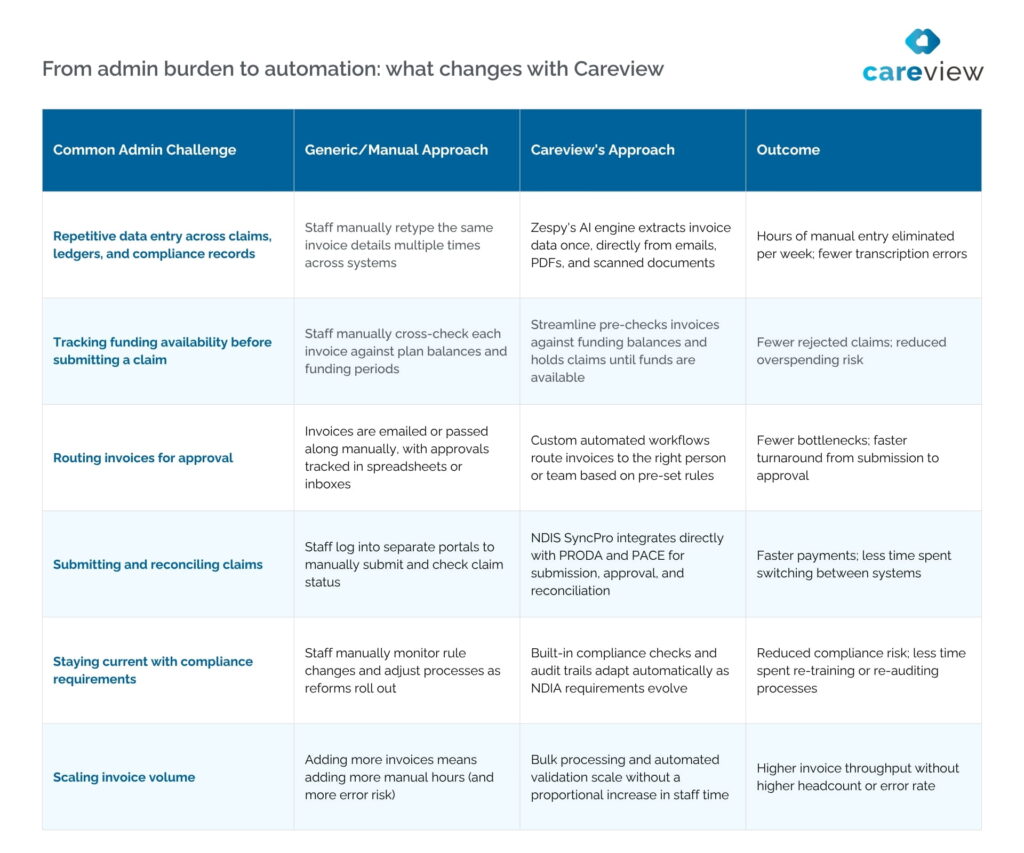
What used to take minutes per invoice now happens in seconds, and at scale, that difference adds up to hours saved every week.
This isn’t just an NDIS-specific efficiency gain — it’s the same “double data entry” problem that plan managers, providers, and coordinators across the disability sector are trying to solve.
Whether you’re managing five invoices a day or five hundred, cutting manual data entry out of the process is one of the fastest ways to reduce admin burden and free up staff time for higher-value work.
Claims are prepared for submission with minimal intervention, while built-in accuracy checks reduce the risk of rejection. For more complex workflows, Careview’s NDIS SyncPro adds deep PRODA and PACE integration, automating service bookings, contracts, and claim submissions.
Together, these systems give plan managers the tools to meet compliance requirements while scaling efficiently.
How Funding Periods Change Invoice Timing
From 9 October 2024, the NDIA introduced funding periods for all newly approved plans. This change, outlined in Section 33 of the legislation, means plans now include:
- Total funding amounts – the overall budget allocated to the plan.
- Funding component amounts – the budget available for specific supports or categories.
- Funding periods – the time blocks during which certain funds are released and must be managed.
This structure clarifies how much funding is available, when it becomes accessible, and how long it needs to last. Importantly, funding periods are not fixed at three months. Initially, from 9 October 2024, funding periods were set at 12 months. From 19 May 2025 onward, the NDIA began introducing funding periods that are usually set at three months, but they can vary depending on the participant’s needs and plan design.
For plan managers, this means you cannot assume that funds will always refresh quarterly. Instead, you need to carefully check each participant’s plan to understand their funding release schedule.
Why it matters for plan managers
Invoice timing is as critical as the total budget. Submitting a claim outside the allocated funding period risks rejection.
Overspending early creates risk. Once the allocation for a period is used, additional claims will not be reimbursed.
Unspent funds roll forward. Carrying balances forward into the next period can be a strategic way to manage fluctuating support needs.
How invoice automation helps
Careview’s Streamline and Careview’s NDIS SyncPro make it easier to stay aligned with funding periods by:
- Pre-checking invoices against funding balances before submission.
- Holding and scheduling claims to be released when funds become available.
- Flagging overspending risks early, ensuring compliance with NDIS invoicing and record-keeping requirements.

NDIA Reforms & Compliance: The Bigger Picture
The NDIA is gradually introducing a series of reforms designed to make the Scheme fairer, easier to navigate, and sustainable for the long term. These changes are based on feedback from people with disability, families, providers, and the findings of the NDIS Review, which confirmed the need for a simpler, more consistent, and participant-focused system.
Some reforms are already in place. A new definition of NDIS support has been introduced to clarify what the Scheme will and won’t fund, helping providers and participants make clearer decisions. Funding periods are now part of all new and reassessed plans, supporting better budgeting and long-term sustainability. Participants entering the NDIS in 2025 also began receiving impairment information as part of their access decision, providing greater transparency about eligibility and support options.
On 19 August 2026, Parliament passed the next major reform package – legislation aimed at making the Scheme safer, clearer, and more financially sustainable. The Bill is subject to Royal Assent. While the biggest structural changes (like new eligibility testing) won’t land until 2028, several changes with direct implications for plan managers begin phasing in within weeks or months, including:
- A 90-day claims window, requiring supports to be claimed within 90 days of delivery
- A shift from “plan continuations” to “plan renewals”, changing how reassessed plans are administered
- The removal of unspent funds carrying over between plans
- Expanded NDIA fraud and integrity powers, alongside updates to how NDIS prices are set
- Continued rollout of mandatory provider registration for higher-risk supports
For plan managers, the message is unchanged, just louder: the rules and processes will keep evolving, and often on short notice.
This is where invoice automation becomes invaluable. Systems like Careview’s Streamline and Careview’s NDIS SyncPro help plan managers adapt with confidence by:
- Providing automatic compliance checks and audit trails
- Aligning invoices with current NDIS invoicing and record-keeping requirements
- Flagging claims approaching the 90-day submission deadline before they lapse
- Offering flexibility to adjust processes quickly when reforms are introduced
In short, automation future-proofs your operations against shifting rules while keeping compliance at the forefront.
NDIA Reforms & Compliance: The Bigger Picture
The NDIA is gradually introducing a series of reforms designed to make the Scheme fairer, easier to navigate, and sustainable for the long term. These changes are based on feedback from people with disability, families, providers, and the findings of the NDIS Review, which confirmed the need for a simpler, more consistent, and participant-focused system.
Some reforms are already in place. A new definition of NDIS support has been introduced to clarify what the Scheme will and won’t fund, helping providers and participants make clearer decisions. Funding periods are now part of all new and reassessed plans, supporting better budgeting and long-term sustainability. Participants entering the NDIS in 2025 also began receiving impairment information as part of their access decision, providing greater transparency about eligibility and support options.
While larger planning changes have been delayed to mid-2026, the message for plan managers is clear: the rules and processes will continue to evolve.
This is where invoice automation becomes invaluable. Systems like Careview’s Streamline and Careview’s NDIS SyncPro help plan managers adapt with confidence by:
- Providing automatic compliance checks and audit trails
- Aligning invoices with current NDIS invoicing and record-keeping requirements
- Offering flexibility to adjust processes quickly when reforms are introduced
In short, automation future-proofs your operations against shifting rules while keeping compliance at the forefront.
The Process of Invoice Automation: Step by Step
An invoice automation system is designed to take the complexity out of processing claims by following a clear, repeatable workflow. For plan managers, the process can be broken down into four key steps:

Step 1: Capture Invoices are collected digitally, whether uploaded, scanned, or received through eInvoicing. Systems like Careview’s Streamline automatically extract the key details from email attachments or folder documents, ready for processing.
Step 2: Validation The system cross-checks invoice data against NDIS claiming rules and participant funding periods. This ensures that claims don’t exceed plan balances or funding allocations and that required information is present before submission.
Step 3: Approval workflow Once validated, invoices move through automated workflows for approval. Plan managers can set up rules for routing invoices to the right person, team, or system, reducing bottlenecks and manual follow-ups.
Step 4: Payment processing Approved invoices are pushed through for payment, with full audit trails created along the way. In Careview’s NDIS SyncPro, PRODA integration enables instant submission, approval, and reconciliation directly with the NDIA.
By automating these steps, plan managers can automate invoices with confidence, reduce administrative overheads, and maintain compliance while ensuring timely payments for providers and participants.
Invoice Automation Systems & Software Options
There are several categories of automated invoicing software available to plan managers, each with different strengths:
- Dedicated invoice automation software Standalone systems focus solely on capturing, validating, and processing invoices. While effective, they often require additional tools for compliance with NDIS requirements.
- NDIS-specific platforms Platforms like Careview combine invoice automation systems with broader plan management functions. Streamline handles invoice capture and processing with Zespy’s AI engine, while Careview’s NDIS SyncPro integrates directly with PRODA and PACE for seamless service bookings, contracts, and claim submissions.
- Accounting systems with automation add-ons General accounting platforms such as MYOB or Xero sometimes include invoice automation features. However, they typically lack the NDIS-specific compliance checks and reporting that plan managers require.
For plan managers, the priority is not just faster processing but also compliance, accuracy, and scalability. An invoice automation system designed with the NDIS in mind ensures that invoices meet regulatory standards, align with funding periods, and adapt as NDIA reforms continue to roll out.
Careview is not a replacement for your accounting system. Streamline exports to Xero, MYOB and QuickBooks, so claiming and reconciliation stay connected rather than becoming two disconnected jobs.
Key Features to Look for in an Invoice Automation System
When selecting an invoice automation system, plan managers should look for features that go beyond simple data entry:
- Bulk processing – Handle large volumes of invoices efficiently, saving staff time.
- Compliance and error checks – Validate against NDIS invoicing and record-keeping requirements and funding period balances before submission.
- Custom workflows – Route invoices automatically for approval based on rules you set, minimising bottlenecks.
- Integration with NDIS systems – Direct links with PRODA and PACE for instant claim submission, approval, and reconciliation.
- eInvoicing support – Accept and process invoices in electronic formats for greater accuracy and speed.

The Future of Invoice Automation in Plan Management
As the NDIA continues to roll out reforms, the invoicing landscape for plan managers will only grow more complex. Funding periods, new definitions of NDIS supports, and evolving compliance requirements mean that manual processes will no longer be sustainable.
Invoice automation systems will shift from being a competitive advantage to an operational necessity. By adopting platforms like Careview’s Streamline and Careview’s NDIS SyncPro, plan managers can stay ahead of reforms, reduce risk, and deliver services with confidence. Automation isn’t just about efficiency; it’s about building resilience in a rapidly changing NDIS environment.
Ready to Embrace Invoice Automation?
Invoice automation is more than a time-saver; it’s a strategic tool for plan managers. It reduces administrative costs, minimises compliance risks, and ensures accuracy in line with NDIA funding periods and invoicing requirements.
Most plan managers move across in stages rather than switching everything at once. Streamline can run alongside existing processes while your team builds confidence in the extraction accuracy.
With the 2026 reforms now legislated and rolling out gradually, the case for getting the process right has only strengthened.
Ready to simplify your invoicing? Contact us today to learn more or request a demo.
FAQs
How does invoicing automation help with NDIS compliance?
Invoicing automation helps NDIS plan managers stay compliant by checking claims against funding periods, plan balances, and NDIS invoicing and record-keeping requirements before submission. This reduces the risk of rejected claims and helps ensure invoices are only submitted when funds are actually available.
Does automated invoicing reduce manual data entry?
Yes. Automated invoicing systems like Careview’s Streamline use AI-driven data extraction to pull key details directly from invoices, emails, and documents, removing the need for staff to manually type in line items, totals, and participant information.
What happens if a claim is rejected?
Claim statuses return into Careview rather than staying in the portal. Rejected claims can be corrected and resubmitted without starting over, and declined invoices can trigger an automatic notification to the service provider.
What’s the difference between invoice automation and general accounting software?
General accounting platforms like MYOB or Xero can include invoice automation features, but they typically lack NDIS-specific compliance checks, funding period tracking, and PRODA/PACE integration. NDIS-specific platforms like Careview are built to handle these requirements directly.
How is an invoice automation system different from an automated invoicing add-on?
A dedicated invoice automation system is designed to handle the entire invoice lifecycle, capture, validation, approval, and payment – within one workflow. Add-ons, by contrast, usually automate only part of the process and often need to be paired with other tools to achieve full compliance and reporting.